
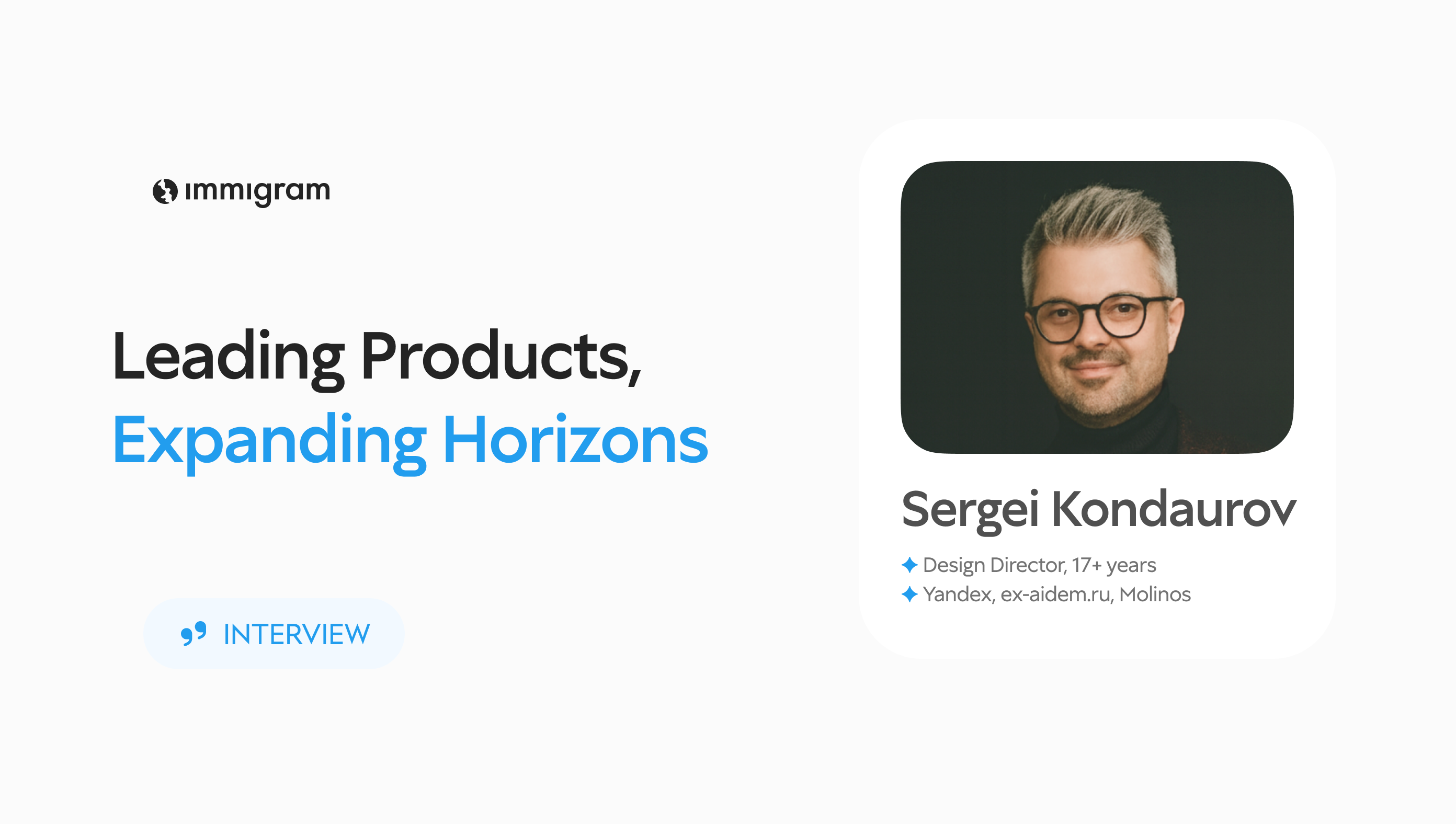
I joined Yandex in 2015 as Art Director for search and information services, including Images, Video, News, Translator, Dictionaries, Travel, and Electric Trains. At the time, many large services had no in-house designers or only one or two without supervision. I quickly delivered strong results, improving both the team and the quality of their work. Within six months to a year, I took on additional services under my leadership, including personal services (Mail, Disk, etc.), Direct, Metrica, dozens of internal tools, and experimental projects like Alice and the first Alice smart speaker.
In 2019, I realized that horizontal growth no longer interested me. At the start of 2020, I handed almost all services to other Yandex art directors and focused entirely on Alice. Back then, Alice was a small but promising experimental service, with two smart speakers, a chat-bot app, and a team of three designers. The move paid off: today Alice is Russia’s most popular AI service (in December, it surpassed all competitors in the App Store), one of Yandex’s key strategic bets, with dozens of devices, its own smart home system, a smart TV OS, an OS for the Duo Max speaker, and many experimental products in development.
From 2015 to 2020, I focused on everything that helped the company succeed. This brought me “horizontal” growth — the fastest career advancement and increased income. From 2020 onwards, I focused on products and projects I chose myself. This brought me “vertical” growth — the greatest professional development and direct involvement in major launches and patents.
This attracted the interest of conference organizers, podcasts, and interviewers. Based on this experience, I started the Telegram channel, which quickly grew to over 3,000 subscribers. All of this became the foundation for my GTV application.
I first heard about a similar visa in the US 11 years ago. I realized I wanted such a visa because I didn’t want to be tied to a single employer and was determined to work at Google.
At that time, I was working as an art director in a small St. Petersburg studio. I decided to join Yandex for a year to gain the achievements needed to qualify for the visa. Over time, I realized I enjoyed working at Yandex, but I didn’t give up on the idea of a talent visa: I continued attending conferences and interviews, writing articles, and working on the most challenging projects I could access.
Over the years, I learned a lot about life in the US and realized I preferred Europe.
In 2019, I learned about the UK Global Talent visa from my former manager, Vanya Vasilyev. The idea of this visa excited me — everything was in place. The only obstacle was that, at the time, it wasn’t possible to work remotely for Yandex, and I wasn’t ready to leave the company.
In 2020, remote work was introduced at Yandex. I spent several years studying the experiences of fellow Russians living in other European countries, exploring visa options, and mentally preparing for relocation. By 2023, I realized I was ready to move to the UK and contacted Immigram.
I was constantly preparing my case in the background. I had heard about Immigram from colleagues who had successfully obtained visas through them, so I didn’t explore other options. I wouldn’t have managed it alone — I know myself: I go to the gym with a trainer, study English with a teacher, and prepared my case with Immigram.
I prepared my case very slowly, over the course of a year. I appreciated that Immigram didn’t pressure me — they politely reminded and encouraged me. I would disappear for a month and then come back, and never once did I hear any reproach. The team patiently answered dozens of questions, reviewed what I had written, and helped me select the strongest examples.
I was surprised to learn that experience has a “shelf life” — no more than five years. It was difficult for me to let go of “outdated” cases, and Immigram provided excellent guidance. It was also hard to praise myself. In Western culture, you’re expected to write things like: “I launched a service, I saved a project, and thanks to my work, the metrics grew by X percent…” Immigram helped rewrite my case so that the focus was correct.
I got married! Now my wife and I live in Oxford, a beautiful Gothic city. I have many plans in mind, but no spoilers.
Everyone’s path is different. It’s definitely better to first visit the country as a tourist to see it with your own eyes. If remote work is possible, I’d recommend coming for three to four weeks: a couple of weeks of vacation, traveling around England, Scotland, and Wales. Rent an Airbnb and work remotely from a city you like. If you enjoy the UK and have a strong chance of obtaining the Global Talent visa, go for it — it’s much better than relocating on a work visa.


