
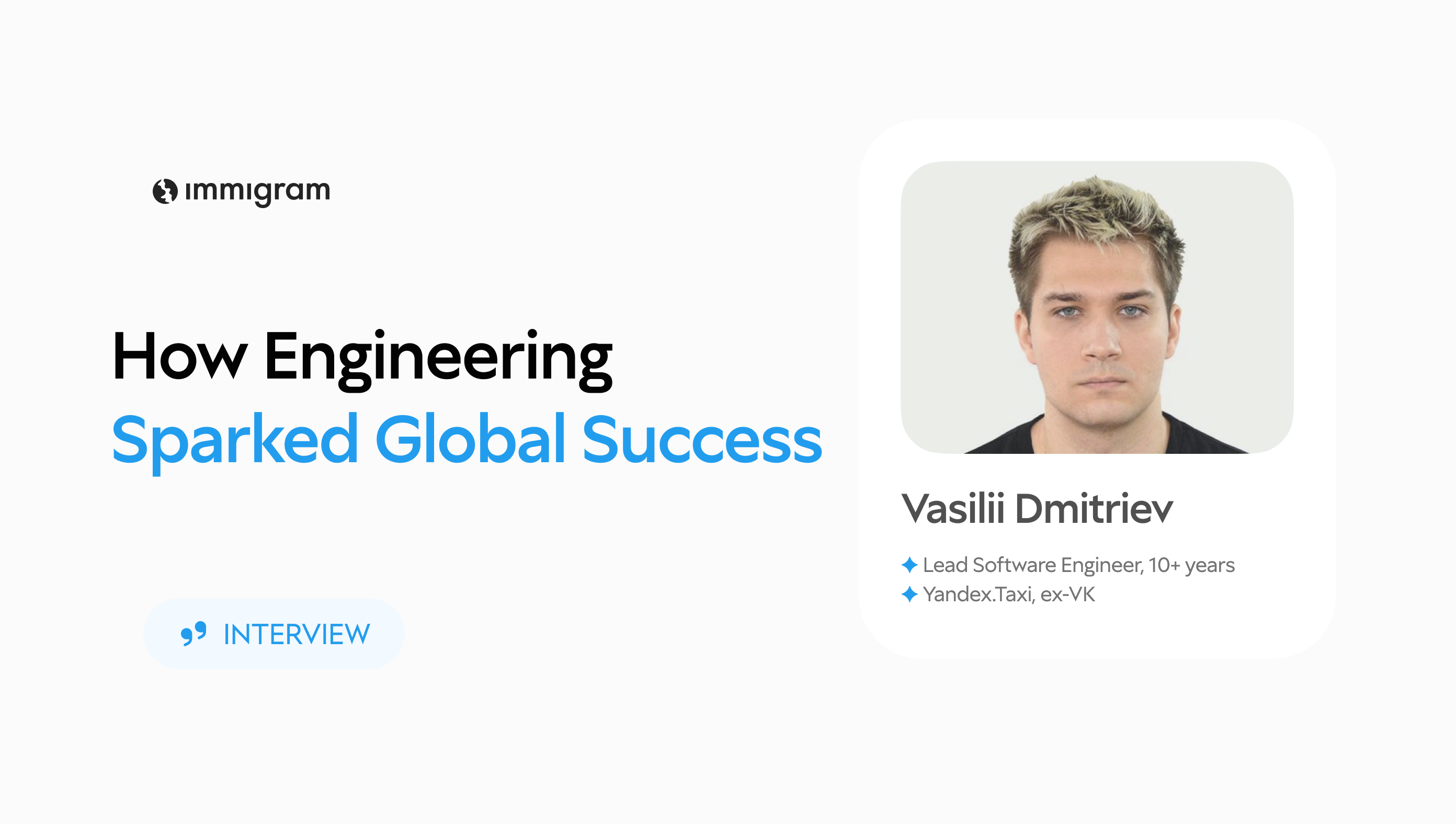
The story of Vasilii Dmitriev, a Lead Software Engineer at Yandex, proves that the sky is the limit when you do what you love and love what you do. He says he could never have imagined graduating from one of the top universities in the country, landing a job at a leading digital corporation, and eventually moving to the UK on a Talent Visa. Yet, he has done it all.
His recipe for success is surprisingly simple: find something you are truly passionate about. In this interview, he shares how he applied for a Talent Visa just for the thrill of it—and ended up succeeding.
My life has always been full of surprises. If someone had told me I’d get into Bauman Moscow State Technical University, I would have laughed. If they had said I’d end up working at Yandex, I would have laughed even harder. And if they had told me I’d eventually move to London on an Exceptional Talent Visa, I would have laughed the hardest. The list could go on… yet, all of it happened.
But jokes aside, I never really had a grand plan—I was just doing what I love. Not just as a job, but as a passion, something I immersed myself in 24/7. Over the years, I’ve learned that if you fully commit to something you truly love, success will follow.
Frankly, I never had a solid plan to move to the UK. But when an opportunity came up, I decided to give it a shot. The UK seemed like a place where a lot of brainy techies go for better financial opportunities—whether to try their hand at FAANG or find a co-founder to build their own project or product.
London is a big, beautiful city with a rich culture, lots of bars, and amazing architecture. It’s worth visiting even just as a tourist. And if you get the chance to move there, and nothing is holding you back, why not give it a try? That’s how I saw it.
I didn’t consider any other programs, and to be honest, I don’t even know what other options exist!
I first found Immigram while reading Forbes. I liked the concept behind their business model and decided to take their test to estimate my chances of getting a Global Talent Visa. The algorithm gave me a 40% chance, and I laughed, thinking, “Your algorithm doesn’t work.” Then I completely forgot about them.
In January 2024, they reached out, saying my profile actually had a strong chance. I laughed again, pointing out what the algorithm had said, but they told me it sometimes glitches. That’s how we started working on my case.
I had to describe my key projects in as much detail as possible and ideally provide proof in the form of analytics, screenshots, etc. I also needed to find people I had either worked with in the past or was working with at the time—industry-recognized professionals who could sign a recommendation letter.
The biggest challenge was arranging podcasts since my public profile was the weakest part of my application, and my Yandex talks didn’t count under Tech Nation’s rules. I also had to carefully select projects that showcased impact and innovation. Using the STAR method, I structured my contributions clearly. To add credibility, I backed claims with metrics and feedback. I sought advice from mentors, colleagues, and immigration lawyers. After multiple revisions, I balanced technical accuracy with accessibility, ensuring my case was strong and compelling.
As a developer, I can only give advice to developers—get active on GitHub, contribute to projects, build your own apps and services, and take on impactful challenges at work. Focus on tasks that reach a wide audience or create measurable value.
I did all of this without even knowing about services like Immigram, and it helped me tremendously. If you truly love what you do, assembling your case will be faster and easier. Good luck!


