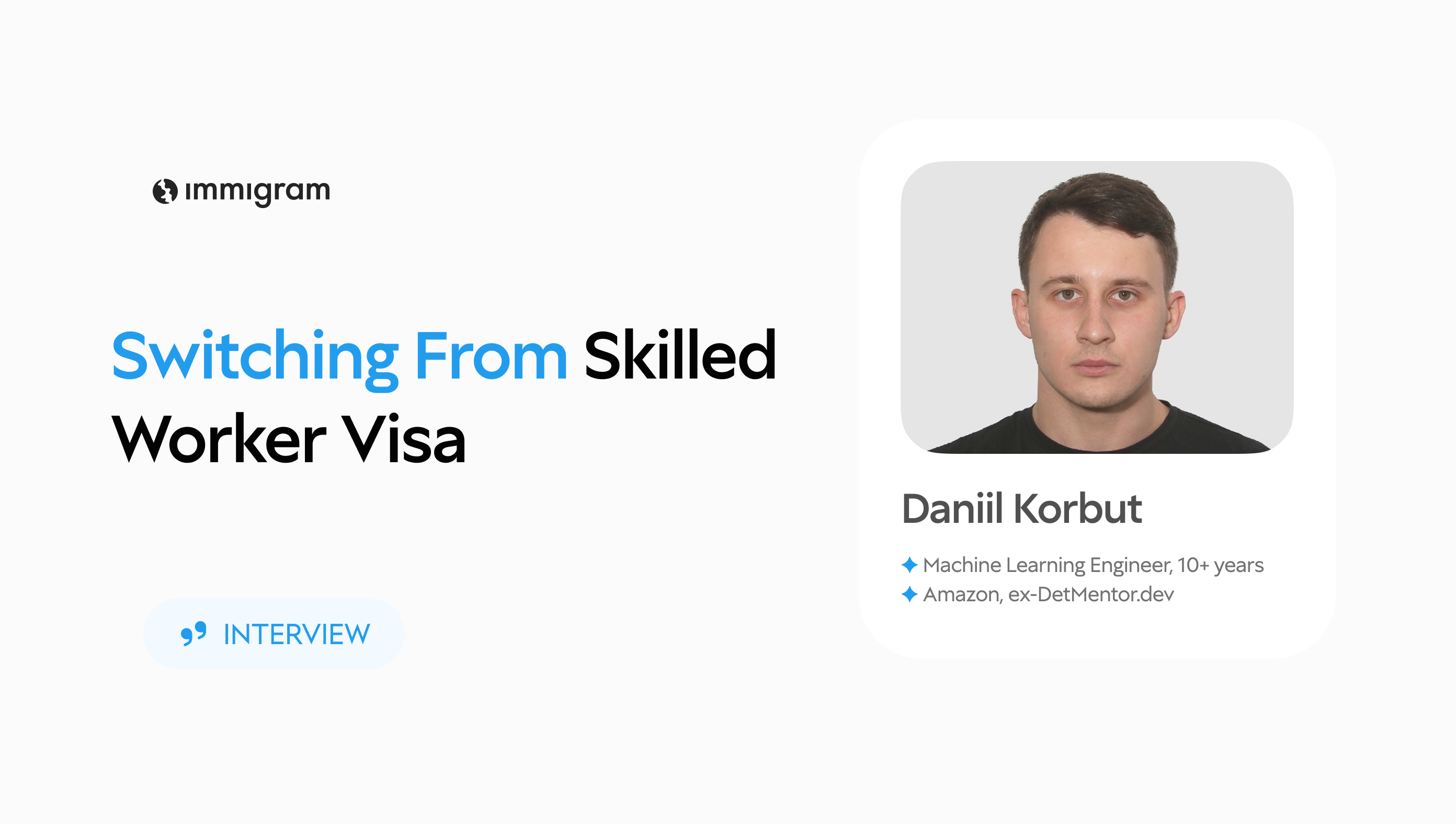
Being “layoff-proof” is something every professional on a work visa in a foreign country would like to achieve. Daniil Korbut, a proficient Machine Learning Engineer with a strong background in AI and data science, decided he wanted to be independent from an employer while working at Amazon on a Skilled Worker visa. Before that, he didn’t think he needed a Global Talent visa — the one that doesn’t tie you to a particular job. But he decided to give it a try, and succeeded. With this, he gained a peace of mind he hadn’t had before. In this interview, he shares his journey.
There haven’t been any major career changes — I’ve continued working at Amazon — but I’ve gained more confidence and peace of mind, with greater focus on my work (without the constant background worry about a visa). About a year ago, I also moved to a research team within my department.
Before moving to the UK, I had worked at Yandex.Alice, Insilico Medicine, Microsoft, and PicsArt. I first heard about the visa after I had already relocated to London on a work visa, working in an MLE role at Deliveroo. By that time, I already had publications, a patent under review, and three years of teaching experience, but I didn’t feel the need or confidence to apply for the Global Talent visa. In 2022, I moved from Deliveroo to Amazon, and the first waves of layoffs in Big Tech became the main push for me to act. I realized it was the right time, and that the necessary criteria for the visa could be refined during the case preparation.
For IT professionals, this seemed like one of the simplest ways to switch from a Skilled Worker visa to a visa that frees you from employer sponsorship. Also, more than a dozen of my close friends had already successfully gone through the Global Talent visa process with Immigram, so the process and requirements were fairly clear to me.
There were a couple of reasons. I started preparing my case during my first months at Amazon, which was already quite busy with a flow of new information, plus the stress from mass layoffs. I wanted to feel more confident and avoid wasting multiple attempts submitting to Tech Nation. I also had a somewhat unusual employment situation in one of my previous companies, where my full-time contract format might not have been accepted by Tech Nation if I had applied on my own. Immigram helped me phrase the employment documentation properly, and in the end, there were no issues.
I first had a call with the team in November and took some time to think about the decision. I made the final decision to proceed in December, after which I spent the first month recalling all the projects I had worked on and identifying potential referees who could provide recommendation letters.
The process was iterative and quite straightforward. First, I described all the projects I had worked on in the past, including their key metrics and impact. I also compiled a list of mentions of me, public talks, teaching, and publications — about half of which I hadn’t even noticed before starting the case. What surprised me most was the level of detail required when describing projects and achievements. I only submitted one project from Amazon, which I had already completed, but I realized that with such detailed requirements, it might have been difficult to get reference letters signed by Amazon managers due to the strict NDA policy.
I would advise not to doubt yourself and not to postpone working on your case for another year or two if you feel unsure. This visa is, in a way, like a tough interview: there are clear rules of the game and a set of criteria you need to meet. If you genuinely want the visa, then once you understand those rules, preparing your case and supporting documents becomes simply a matter of time and effort.