
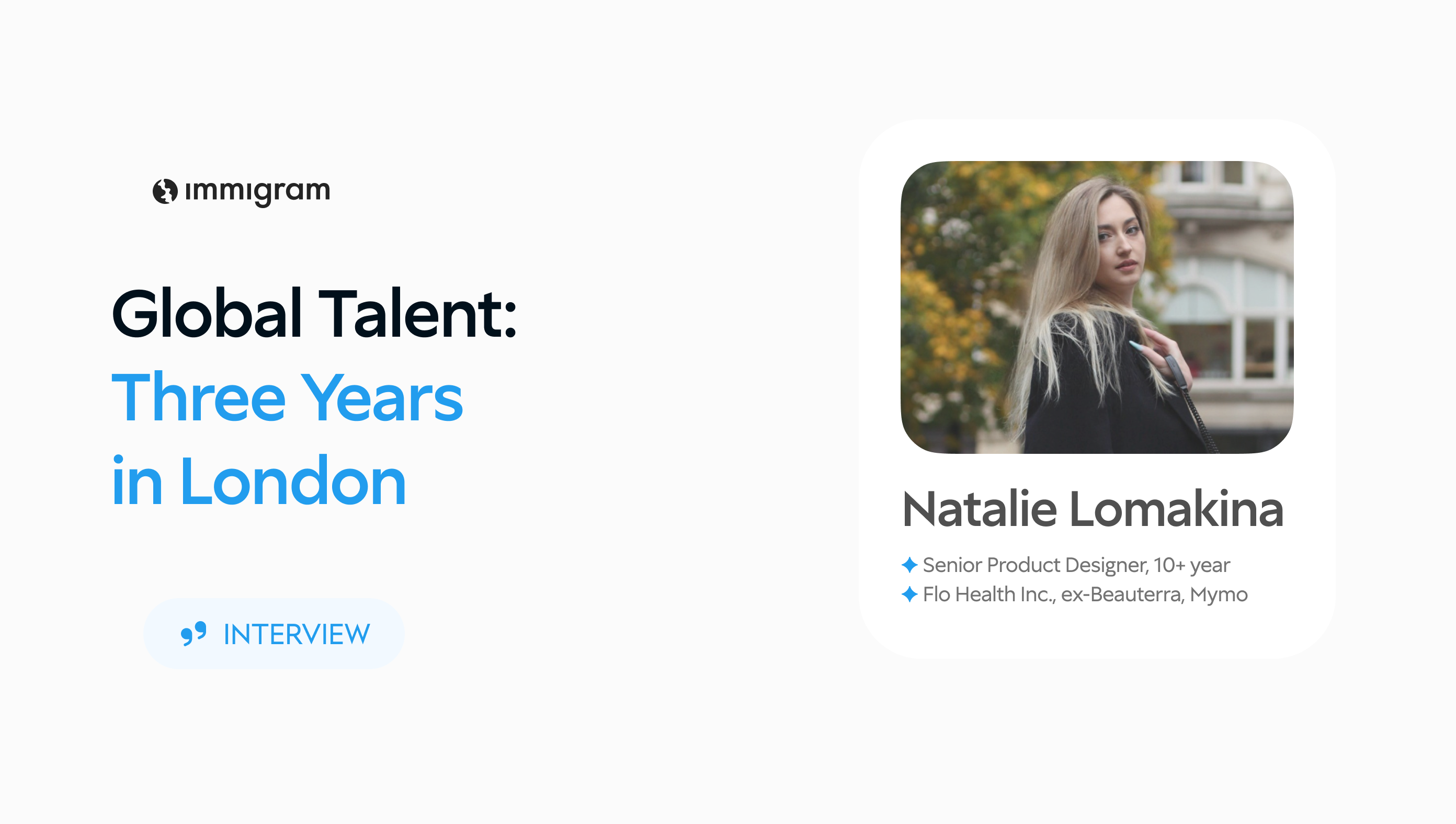
For Natalie Lomakina, a digital product designer passionate about the startup ecosystem, working internationally was a long-held dream. However, the Skilled Worker Visa seemed too risky. When she discovered the Global Talent Visa, she was able to relocate to the UK. Three years later, she shares how her life has changed, the projects she’s worked on, and her first entrepreneurial experience.
I moved to London almost three years ago, in the summer of 2022, and of course, my life has changed a lot. First of all, because Britain is very different from the places I lived before. Everything in London is organized differently, from finding an apartment to opening a bank account.
Emigration, even when it's long-awaited and desired, as in my case, is not super easy. You don't have the same circle of people that you had before, and your habits change. But this is especially felt in the first year or so. However, it’s an amazing experience that I wouldn't trade for anything else. And, of course, I don’t regret moving.
For just over a year, I’ve been working at Flo Health Inc., the world’s leading period and ovulation tracker. It’s all about women’s health, and my projects here are, of course, focused on health. I can’t talk about all of them, but most of the projects I’m involved in are about better understanding the female body, what premenstrual syndrome is, and everything related to it. But, of course, there are also projects focused on standard metrics improvement. It’s all very interesting because, in addition to being popular, it’s really useful for people.
When I moved, I was working for a British startup that was like TikTok for beauty influencers, where they reviewed products and earned commissions. Users could also buy products directly from the videos. It was a great experience, especially working with influencers alongside the IT team.
By the time I moved, I had an offer from an American company, which I joined remotely after relocating to London. I worked on an app that helped users track their income sources and calculate taxes. However, both the British and American startups eventually either shut down or significantly downsized.
In 2023, I launched my first startup with former colleagues — a marketplace app. On one side, we had independent beauty artists offering beauty services, and on the other, clients looking for those services.
At the same time, we began developing an app for people with headaches. It analyzes external factors like air pressure, as well as internal factors, such as sleep duration, to predict the likelihood of a migraine and help users take preventive measures.
Definitely, yes. I considered moving to London in 2019 and initially planned to go on a work visa, as I wasn't aware of the Talent Visa. I knew many people who moved to the US on an O-1 visa but none who came to the UK with a similar visa.
I realized that a work visa wasn’t ideal since it ties you to an employer. After nine years working as a designer, mostly in startups (which I love), I knew that startups can be unstable.
I was debating between the O-1 visa for the US or the Skilled Worker visa for the UK, but once I learned about the Talent Visa, my decision was clear. It gave me freedom and the ability to launch my own startup.
It was in February 2022, and I was working at a Russian startup. It just so happened that this startup shut down around that time, and at that moment, I received an offer from a British company. They needed someone who would eventually move to the UK and work in their London office. I had just mentioned that I was planning to apply for the Talent Visa.
I had a friend who recommended Immigram, and they quickly booked a call with you. I also had another co-founder from the UK who was applying for a visa through you, so I had no doubts.
We followed a process with six or seven one-hour calls where I shared my experience, the metrics I worked with, and the documents I could provide for the case. After the calls, Immigram transformed the information into my case, creating a description of my experience and writing the recommendation letters. From the start to about the middle of the process, everything went smoothly with no questions. The only issue came when there was a three-week delay in gathering documents, which added some stress as I was eager to move. But overall, it was a positive experience.
Given the current situation, I’d advise allowing more time. Even with strong experience, such as speaking, teaching, or patents, it still takes about four to five months without the right documentation and talent approval.
I recommend starting with a consultation to understand where your case stands and what’s left to do. I’ve seen cases where people wrote their own articles, but published them on lesser-known platforms.
I’m not a fan of handling documents myself, so I prefer working with someone who understands the process and can properly prepare everything.


